Showing posts with label Bruno Ganz. Show all posts

Saturday, 25 January 2014

Ich bin ein Berliner

Wings of desire (1987)

This is one of the few films that has immediately made an impression on my state of mind. This film is so stunning that words cannot really describe the feelings of awe and adoration for the film and the city and era it portrays. I think the connection comes due being a teenager, therefor having a sense of distance from childhood, yet like the characters in the film, retain an innocence to the routine of adult life. The film is poetic through its script and its lyrical beauty of combining the heavens and mortality in a rich black and white film.

Berlin seems idyllic with its raw creativity and potential. Bombed spaces and disused areas give a beautiful backdrop in which to convey a calm solicitude. Berlin in 1987. The city is alive with rebellious culture due to the political constraints of cold-war society. The wall hinders free movement and is imposing yet the artistic graffiti corrodes the wall as a symbol of authority like a disease. Yet still capitalist West Berlin is separated from the waning communist east.

Bruno Ganz (Hitler in Downfall) creates a character who is extremely complex in beliefs and attitude towards life and whether his position as an immortal angel constrains or enriches his resolve. With a teddy bear-esque enthusiasm he surveys the city and gives a warm touch to those in need. In my mind he has a unconventional handsomeness which elevates him to a position of strength and legitimacy. His long rich cotton winter coat (the preferred outfit of the angels) gives a sense of anonymity as they blend into the hollowed out Berlin.

The film is extremely musical although its not its ultimate priority. As previously described, the poetic script could be seen as spoken word, and for once, the German language is as flowing and dulcet as french, and has a melodic intonation as varied as English is perceived to have. More obviously the actual soundtrack feels so perfect its holy.

Nick Cave and the Bad Seeds feature as themselves in a scene where the two  lovers (Bruno Ganz as the angel Damiel and Solvieg Donmartin as Marion) meander through the amazingly 80s crowd at the amazingly raw concert. The live energy delivered by Nick Cave is electrifying despite being shot in solemn black and white. Another scene where the two characters are transposed onto a idea of heaven makes me think of a Kate Bush music video.
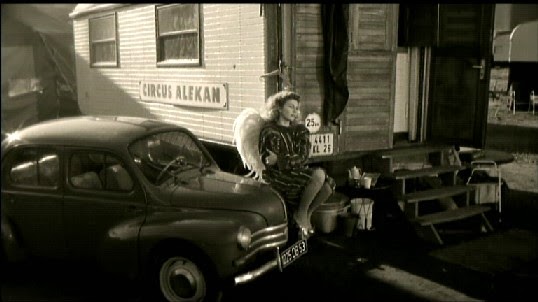
After watching the behind the scenes, it has exposed me to an alternative kind of creativity. Director Wim Wenders prompted the idea that this story was thought up after a near death experience involving an overdose whilst frivolously experimented with hash-brownies.

The correlation in a way gives some further depth to the story to know it is influenced by real circumstances.

This modern fairytale is lusciously symbolic and this ensures that repeated viewings is required - which is certainly a bonus. Moreover, the film acts as a time capsule for the underground rock scene of Berlin, which luckily has of yet escaped being affected by cheesy nostalgia.

Wings of Desire really is too divine to put into words - when watching, if in the right mood, it almost becomes a numinous experience.

Sunday, 13 October 2013

Is this Germany efficiency?

I was harshly awakened when I watched Downfall (2004) early this morning; in the comfort of my own home I witnessed the stark brutality and futile nature of the Nazi's last resistance of the ruin that was Berlin. As the scenes of claustrophobia unfurled inside the Nazi bunker, I felt angry and uneasy, but also pity for the disillusioned followers of Nazism, under the assumption that their decrepit Fuhrer Adolf Hitler, would rise up like Jesus or some biblical figure to resurrect the dream of a glorious state of National Socialism. 

I believe the unease created by Oliver Hirschbiegel is mainly because Adolf Hitler is portrayed with some kind emotions, and you see how people actually like him when a young Frau Junge is ecstatic that she has received the job as Hitler's PA. There is no excuse for Hitler to seem 'nice' or human (he even has a wife!). With knowledge of the context, the truth of the concentration camps looms over however this film makes no mention to them. I was speechless after the film to see people wailing and crying at his feet when he announces his suicide. (I hope readers knew this - :/ no spoilers). 

(this has many hilarious parodies)

Hitler's character is fantastically acted and for a 15 year old like me, Bruno Ganz's depiction makes Hitler on screen seem real enough for me. I watched with rapt attention Hitler's frantic hand rotation and jerks. This for me symbolises madness or suppressed fear for me, knowing Hitler suppresses most emotion and feeling; firmly believing that pity and compassion are sins and in conflict with the laws of the Darwinian idea of natural selection. Mood swings are common features of Hitler's controversial personality displayed in this film - his raucous anger attacks leading to rants and disappointment in his incompetent generals. At these points the director reduces him to a spoilt child,  whose elaborate ideals of fantasy land are not going according to plan and he wants everyone to drop everything therefore he has complete tyrannical control.

The bleakness of the film tears all aspiration for the following day out of you. You can not leave the cinema feeling any kind of elation, for if you do the film has not connected with you at all. The claustrophobia of the bunker consumes you to, it is incestuous. Life in this film is portrayed as meaningless, as if individuals are part of a large clockwork that makes up Nazism, and when too many of these parts (the generals/soldiers) die due to war, or the main cog (leader) dies, then it is the other cogs (the civilians) duty to break the rest of the clockwork by commiting suicide instead of aiming to repair it. It comes to point where staunch followers truly believe that living in a world without National Socialism is worse than living at all. Joseph Goebels (the ultimate creep in the whole film) certainly exceeded in the job of propaganda minister. 

The film is horrifically solemn and if there is any light of comedy it it sure to be quashed in the proceeding scenes. There is a lack of soundtrack, of which the only few melodies are again remorseful German laments played on the piano, sounding as if they have given up on conveying meaning. The overall atmosphere is drab and bleak. In the night orangey-yellow lamps shine halfheartedly knowing they can never provide enough protection and comfort for the panicked citizens of fortified Berlin. 

This film is very hard to critique if you submerge yourself in the story as you are reviewing the true horrors of WWII; it is hard to stay indifferent and view it as 'just another film'

****